
MSME Mergers and Acquisitions in India: A Dealmaker's Playbook
Most writing about mergers and acquisitions in India is about big companies: the billion-dollar acquisition, the unicorn round, the mainboard IPO. This is a practical guide for smaller companies. This series is about the rest of the market, where most Indian businesses sit.
India has 7.83 crore businesses registered on Udyam (PIB, 2026a). Every year, thousands of their owners try to raise a loan, sell a stake, sell the company or raise growth capital. Most do it without professional help.
This playbook covers MSME mergers and acquisitions in India and MSME funding: the four main avenues, each market today, and where a chartered accountant (CA) fits in. It's the map. I'll go deeper in later posts.
What are the four ways to raise money or sell?
MSME funding comes as debt or equity. A sale gives the owner an exit, and startups have their own route.
- Debt: bank and NBFC loans for working capital, expansion and equipment.
- Sale: a stake or the whole company, to a strategic buyer, a PE fund or a family office.
- Equity: an SME IPO, or a private raise from family offices and smaller funds.
- Startup capital: angels, VC funds and family offices.
1. How can an MSME raise debt?
Through bank and NBFC loans. Credit is cheaper than it was, but getting it is still the hard part.
What's the market like?
- The RBI cut the repo rate from 6.5% in December 2024 to 5.25%, and has held it there so far in 2026 (ClearTax, 2026).
- Credit quality is holding up. Delinquency in commercial lending was broadly stable at 1.8% in March 2026 (TransUnion CIBIL and SIDBI, 2026).
- Only 41% of registered MSMEs have accessed formal credit (TransUnion CIBIL and SIDBI, 2026). SIDBI puts the MSME credit gap at about ₹30 lakh crore (SIDBI, 2025).
- NBFCs now make up a sizeable share of MSME lending (TransUnion CIBIL and SIDBI, 2026).
What are the options?
- Working capital from your existing bank, usually renewed every year.
- Term loans and loans against property from other banks and NBFCs. NBFCs are often faster and more flexible on collateral.
- Government-backed guarantees. CGTMSE covers collateral-free loans to micro and small enterprises. The Mutual Credit Guarantee Scheme now guarantees 60% of equipment loans of up to ₹100 crore, and 75% of loans of up to ₹20 crore for eligible exporters (PIB, 2026b).
Where does the CA fit?
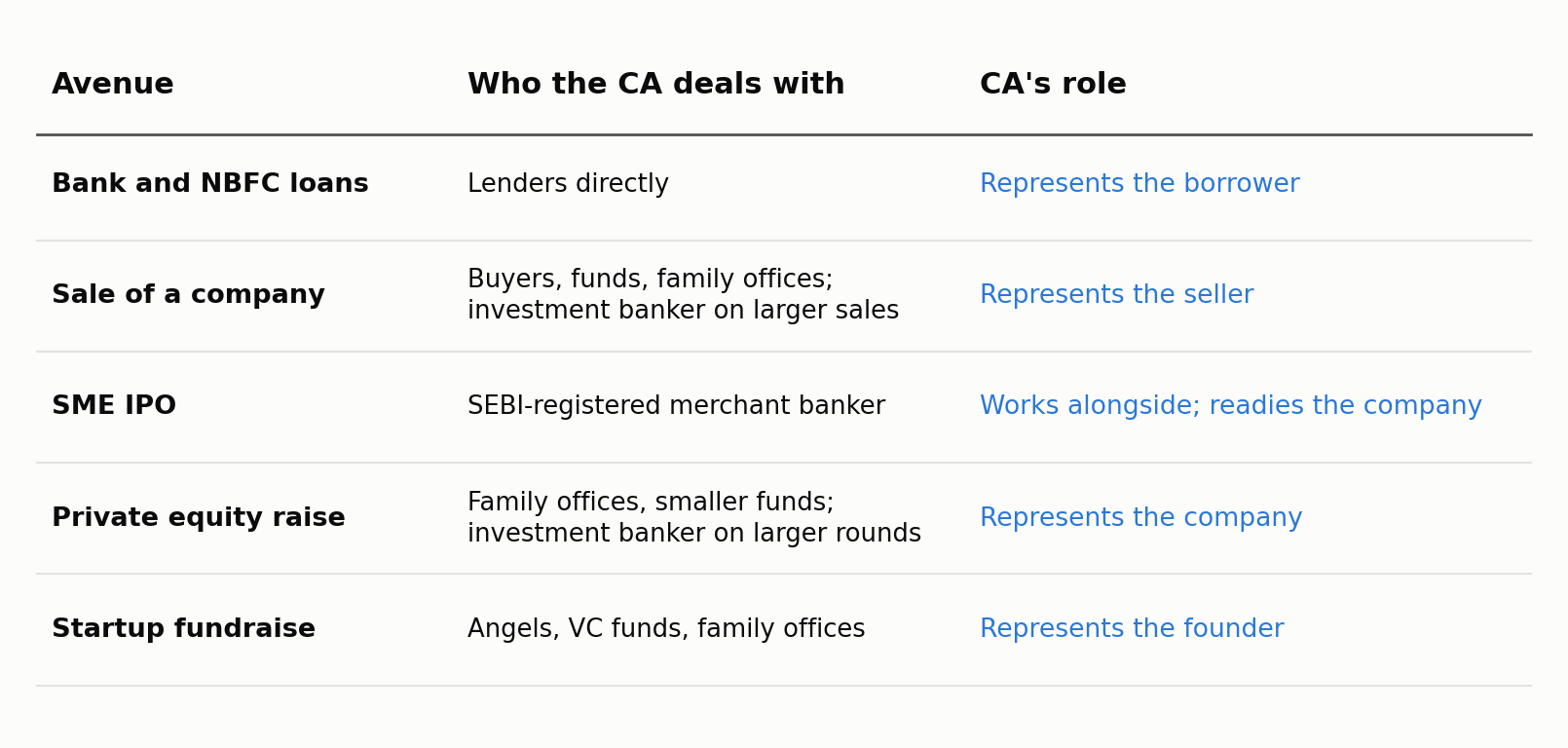
Here the CA is already closest to the work. He prepares the CMA data and project report. Today, that file usually goes to the promoter's existing bank, and he's paid only for the CMA data.
The next step: with the client's consent, take one strong file to several banks and NBFCs. More lenders can mean a lower rate, a larger limit or better terms. That justifies a fee for the fundraise, not just the paperwork. The CA represents the borrower and is paid by the borrower, not the lender.
2. How do mergers and acquisitions in India work for smaller companies?
You sell to a strategic buyer, a PE fund, a family office or an insider. Deal activity is healthy, and buyers are eyeing smaller companies.
What's the market like?
- Mergers and acquisitions in India reached 240 deals worth $27.9 billion in Q2 2026, the highest quarterly value since 2022. Domestic deals made up 64% by number (Grant Thornton Bharat, 2026).
- Succession is the biggest driver for smaller companies. Around a third (36%) of Indian family businesses have no succession plan, against 28% globally (PwC, 2026).
- PE-backed hospital deals in tier-2 and tier-3 cities rose from ₹3,625 crore in 2024 to ₹4,517 crore in 2025 (Medical Buyer, 2026). Funds are building regional groups from smaller hospitals.
What are the options?
- Strategic buyers: a competitor, supplier or customer that wants capacity, a new market or a product line.
- PE roll-ups: funds buy several smaller companies in one sector and combine them.
- Family offices: often patient buyers of steady, profitable businesses.
- Management or family buyouts: a partner, a senior manager or one branch of the family buys out the rest.
Where does the CA fit?
Most MSME sales today run through a broker, a relative, or word of mouth at a trade association. A CA can do better for the seller.
He can get the company ready: clean accounts, a clear shareholding and a realistic valuation. Then he can represent the seller directly with buyers, funds and family offices. On larger or more complex sales, he can team up with an investment banker who reaches more buyers.
3. How can an MSME raise equity from SME IPOs and family offices in India?
You can list on an SME exchange, or raise privately from family offices and smaller funds. Listing is harder now, but private capital is plentiful.
What's the market like?
- In FY26, 111 SME IPOs listed on NSE Emerge and raised ₹5,363 crore. That's 32% fewer issues than in FY25 (ANI, 2026).
- Since March 2025, an SME needs an operating profit of at least ₹1 crore in two of the last three years. The offer for sale is capped at 20% of the issue (Investing.com, 2025).
- Commitments to SEBI-registered AIFs reached ₹17.53 lakh crore in June 2026 (Business Standard, 2026). There were more than 300 family offices in India by 2024 (Business Standard, 2024).
- PE and VC investment fell 36% to $20.5 billion in the first half of 2026. Growth deals were still the largest category, at $7.0 billion across 111 deals (EY, 2026).
What are the options?
- A listing on NSE Emerge or BSE SME, for profitable companies that want a public valuation.
- A minority stake sold to a family office, often on simpler terms than a fund would ask for.
- A growth round from a smaller PE fund or a Category II AIF.
- A pre-IPO round from investors who want in before the company lists.
Where does the CA fit?
An IPO must be managed by a SEBI-registered merchant banker, so the CA works alongside one. He spots clients who are ready, gets their accounts and governance in order, and stays with the promoter throughout. For private raises, he can represent the company directly, preparing the materials and leading the talks with investors.
4. How do startups raise money from VCs, angels and family offices?
Mostly from angels, VC funds and family offices. Funding is steady, not booming, and early-stage rounds are holding up best.
What's the market like?
- Indian startups raised $5.2 billion across 501 deals in the first half of 2026. That was 9% less than a year earlier, though the number of deals rose 7% (Inc42, 2026a).
- Seed funding rose 18% to $478 million, while late-stage funding fell 27% (Inc42, 2026a).
- More than 1,100 investors backed startups in the first half of 2026, and AI startups raised 317% more than a year earlier (Inc42, 2026a).
- Inc42 tracks more than 200 family offices investing in Indian startups. It notes that domestic investors are increasingly leading rounds (Inc42, 2026b).
What are the options?
- Angels and angel networks, for the first cheque.
- Seed and early-stage VC funds.
- Family offices, as lead investors or alongside VCs.
- Venture debt, for startups that already have investors and want a longer runway.
Where does the CA fit?
Many founders already use a CA to set up the company, and for compliance, ESOPs and valuation reports. So he's a natural first adviser when a founder starts to raise. He can represent the founder directly with investors: building the financial model, preparing the data room and helping with term sheets. For larger rounds, he can work alongside a boutique investment banker.
What are the two ways a CA can work?
Across all four avenues, you either work alongside a banker or represent the client directly.
- Alongside a banker. Some deals need a regulated firm, such as a SEBI-registered merchant banker for an IPO. Others benefit from a bigger banker's reach. The banker runs the process and outreach. The CA brings the client, gets the company ready and stays close to the promoter.
- Directly for the client. With lenders, buyers and funds, the CA prepares the materials, approaches the other side with the client's consent, and advises through to closing.
Either way, you work for the client and you're paid by the client. That keeps you in line with ICAI's Code of Ethics. It doesn't let a CA in practice share fees with non-members. Nor can he take commission from NBFCs and other financial institutions (ICAI Ethical Standards Board, n.d.).
One exception: none of this applies to a company you audit. Section 144 of the Companies Act, 2013 bars an auditor from providing investment banking or investment advisory services to that company.
Frequently asked questions
What are the main ways an MSME in India can raise money or sell?
There are four: bank and NBFC loans, a sale of a stake or the whole company, an equity raise, and for startups, venture funding.
Where does MSME funding come from?
Debt comes from banks and NBFCs, sometimes backed by government guarantees such as CGTMSE. Equity comes from a listing, family offices in India or smaller funds.
Can a CA represent an MSME with buyers or investors?
Yes. He can represent the client directly with lenders, buyers, funds and family offices, as long as the company isn't his audit client and the client pays him.
Does a CA need a merchant banker for an SME IPO?
Yes. Only a SEBI-registered merchant banker can manage an IPO. The CA works alongside it and gets the company ready.
Is it a good time for an MSME in India to raise capital?
For debt, yes: rates are lower and credit quality is stable. For equity, private capital is plentiful but investors are pickier, and SME IPOs face a higher bar than before.
Conclusion
Mergers and acquisitions in India aren't just for big companies. MSMEs have more ways to raise money or sell than ever, but most lack a guide. The CA already has the client's trust, knows the numbers and is in every city. He can be that guide in all four avenues.
The key is network access: knowing the right lender, buyer, fund or banker for each client. That's what Deal Network aims to provide: a free, WhatsApp-first introduction platform that connects CAs with bankers, NBFCs and funds based on their profiles. It makes introductions and doesn't act in the deals itself. A client's name is shared only if the CA chooses to, and only with the client's consent.
Disclaimer
This article doesn't apply to audit clients. Under Section 144 of the Companies Act, 2013, a company's auditor can't provide investment banking or investment advisory services to that company. The same bar covers its parent company and the companies under its control.
The same section also bars accounting, bookkeeping and management services. So preparing an audit client for a deal or an IPO isn't allowed either. These limits apply whether the work is done directly or indirectly. That includes work through the auditor's relatives or partners, or any entity the auditor controls or that uses the auditor's name.
If your audit client isn't a company, check ICAI's independence rules before taking on deal work. For all clients, CAs in practice must also follow the Chartered Accountants Act, 1949 and ICAI's Code of Ethics (Government of India, 1949). This article is for information only and isn't investment advice.
References
ANI (2026) 'India IPO fundraising hits record Rs 1.8 lakh crore in FY26, small company listing slows: NSE report', ANI News, 22 April.
Business Standard (2024) 'Family offices rise to 300 since 2018; tier II, III cities in demand: PwC', Business Standard, 3 July.
Business Standard (2026) 'AIF commitments rise 24% to ₹17.53 trillion as of June 2026: Sebi data', Business Standard, 21 September.
ClearTax (2026) Repo rate 2026: current, reverse, SDF, meaning and monetary policy. Available at: https://cleartax.in/s/repo-rate (Accessed: 25 September 2026).
EY (2026) PE/VC investments in India reach US$20.5 billion across 604 deals in 1H2026: EY-IVCA report [Press release], July. Mumbai: EY India.
Government of India (1949) The Chartered Accountants Act, 1949: First and Second Schedules. New Delhi: Government of India.
Grant Thornton Bharat (2026) India Deal Trends Q2 2026. New Delhi: Grant Thornton Bharat.
ICAI Ethical Standards Board (n.d.) Decisions of the Ethical Standards Board, compiled in '20 recent decisions of ICAI Ethical Standards Board', TaxGuru. Available at: https://taxguru.in/chartered-accountant/20-recent-decisions-icai-ethical-standards-board.html (Accessed: 25 September 2026).
Inc42 (2026a) 'Indian startup funding slips 9% to $5.2 Bn in H1 2026', Inc42.
Inc42 (2026b) 'Family office tracker: here's the list of 200+ investors betting big on startups', Inc42, 15 April.
Investing.com (2025) 'SEBI tightens SME IPO rules: profitability criteria, OFS cap introduced', Investing.com India, 11 March.
Medical Buyer (2026) 'Regional hospital hubs draw record private equity investment amid scrutiny', Medical Buyer, 11 September.
PIB (2026a) Over 7.83 crore enterprises registered on Udyam Registration Portal. New Delhi: Press Information Bureau, Government of India.
PIB (2026b) Government modifies Mutual Credit Guarantee Scheme to support MSME manufacturers and exporters in line with Budget 2025-26. New Delhi: Press Information Bureau, Government of India, 21 March.
PwC (2026) PwC's 12th Family Business Survey: India findings. Gurugram: PwC India.
SIDBI (2025) Understanding Indian MSME Sector: Progress and Challenges. Mumbai: Small Industries Development Bank of India.
TransUnion CIBIL and SIDBI (2026) MSME Pulse, July 2026. Mumbai: TransUnion CIBIL.
About the author
Adish Bharadwaj R is a co-founder of Deal Network. He has 10+ years of experience in investment banking.